
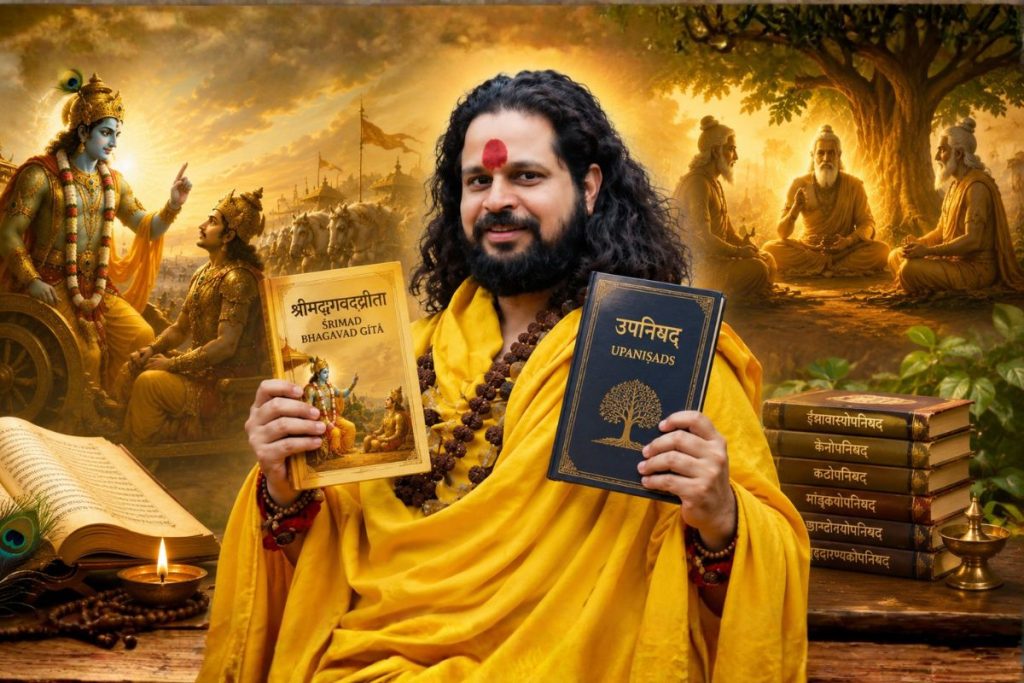
Most of us grow up hearing about the Bhagavad Gita and the Upanishads long before we actually read them. They sit on a shelf at home, respected but untouched. Jagadguru Satish Acharya Ji has built much of his work around changing that, guiding people through Sanatan Dharma teachings to open these texts and see how directly they speak to everyday life.
This blog explains why he places so much weight on the Gita and Upanishads, and what changes when a person begins reading them.
Understanding the Importance of the Gita and Upanishads
Before exploring their impact, here is what each text actually offers.
What Is the Bhagavad Gita?
The Bhagavad Gita is Lord Krishna’s guidance to Arjuna at a moment of complete confusion. Bhagavad Gita teachings are not confined to the battlefield. Honestly, they speak to anyone who’s ever frozen between what they should do and what’s easier, between duty and second-guessing themselves, between comfort and just doing the right thing. The teaching is simple to say, hard to live: act with clarity, act with sincerity, and don’t let fear or the outcome call the shots.
What Are the Upanishads?
The Upanishads don’t hand down answers; they turn the questions inward, toward the self, the mind, the universe itself. That’s the heart of Vedanta: what actually stays constant in us while everything else keeps changing? Along with the Gita, these texts are the backbone of what Indian tradition holds most sacred.
Why Jagadguru Swami Shri Satishacharya Ji Encourages Their Study
Jagadguru Satish Acharya Ji has rewritten scriptures such as the Ashtavakra Gita and the Ramcharitmanas in accessible Hindi, removing the need for years of Sanskrit training before a reader can even begin. His approach to Sanatan dharma teachings rests on one belief: ancient Indian scriptures were never meant to stay locked away for scholars alone.
His guidance draws heavily on dharma, karma, and moksha, the three ideas central to Sanatan Dharma. He explains dharma as accountability to one’s actual role in life, not an abstract virtue, and karma as the principle that every thought and action shapes what follows. Through his Ram Katha discourses and live pravachan sessions, he keeps returning to the Gita and Upanishads because they hold all three ideas in a single teaching that ordinary readers can apply.
How the Gita and Upanishads Address Modern Challenges
The pressures we carry today look different from ancient times, but the emotions behind them are familiar: anxiety, comparison, and a constant search for direction. Reading the Gita and Upanishads works at the root of these struggles.
| What We Struggle With | What the Scriptures Offer |
| Fear of failure | Focus on right action, not attachment to outcomes |
| Feeling directionless | Self-inquiry into one’s true nature |
| Ego and comparison | Detachment through yoga philosophy |
| Overthinking and restlessness | Stillness through Vedanta philosophy |
Guruji’s take on karma hits close to home, that quiet habit of cutting corners the second no one’s looking. But once it actually sinks in that every action carries forward into the next, you can’t really get away with it anymore. Not to yourself, anyway.
Life Lessons Modern Readers Can Learn
A few life lessons from the Bhagavad Gita apply directly to daily decisions:
- Give your full effort without obsessing over the result
- Carry out your responsibilities with sincerity, whatever they may be
- Do not let success or failure define your self-worth
- Remain composed in both comfort and difficulty
- Choose compassion over reaction when dealing with people
The Upanishads add another layer, asking readers to sit with who they are beneath their roles and routines, rather than settling for surface answers.
The Connection Between the Gita, Upanishads, and Holistic Well-Being
You can’t really pull spiritual growth apart from mental and emotional health; they move together. Jagadguru Satish Acharya Ji keeps bringing it back to that: Vedic wisdom, meditation, yoga, a daily practice you actually stick to.
Reading the Gita and Upanishads with consistency can support:
- More stability in emotions during stressful periods
- A calmer, less reactive mind through regular reflection
- A stronger sense of purpose in daily responsibilities
- Inner peace and mindfulness built on understanding, not avoidance
This reflects Sanatan Dharma teachings, in which mind, body, and spirit are addressed together rather than as separate concerns.
How Beginners Can Start Reading the Gita and Upanishads
Honestly, most people never even crack these books open, too intimidating, too much Sanskrit, too easy to put off “for later.” Jagadguru Satish Acharya Ji’s Hindi interpretations cut through that. Here’s where to actually begin:
- Read a few verses daily instead of rushing through the whole text
- Choose a simplified edition over a dense academic translation
- Reflect on one teaching before moving to the next
- Read early in the day, when the mind is less crowded
- Attend a satsang or pravachan session for guided understanding
This unhurried approach lets the meaning settle instead of being skimmed and forgotten.
Benefits of Reading the Gita and the Upanishads
The benefits of reading the Upanishads alongside the Gita extend well beyond ritual observance:
- Clearer thinking and more grounded decision-making
- A calmer response to stress and difficult emotions
- Stronger discipline and a sharper sense of duty
- Renewed connection to Sanatan Dharma and Indian cultural roots
- Gradual movement toward self-realisation and lasting contentment
These outcomes explain why the Gita and Upanishads continue to be recommended across generations.
The Lasting Relevance of Ancient Wisdom
Circumstances change, but the core questions do not. Who are we? How should we act? What actually brings peace? Ancient wisdom for modern life does not ask anyone to reject progress. It asks that progress be rooted in values that do not shift with the moment, work that Jagadguru Satish Acharya Ji carries forward from Maharshi Ashram in Noida, guiding families toward a life shaped by Sanatan dharma rather than constant urgency.
Walk the Path of Sanatan Dharma with Jagadguru Satish Acharya Ji
Reading the Gita and Upanishads is not something to finish once and set aside. It deepens with time and attention. Under the guidance of Jagadguru Satish Acharya Ji, many seekers have found a clearer way to carry these ancient Indian scriptures into daily life.
If you want to explore this path, visit the Literature section for simplified scriptural works, read more about Sanatan Dharma, or join an Online Satsang Pravachan session. For personal guidance, contact us directly.